Large auto parts manufacturer
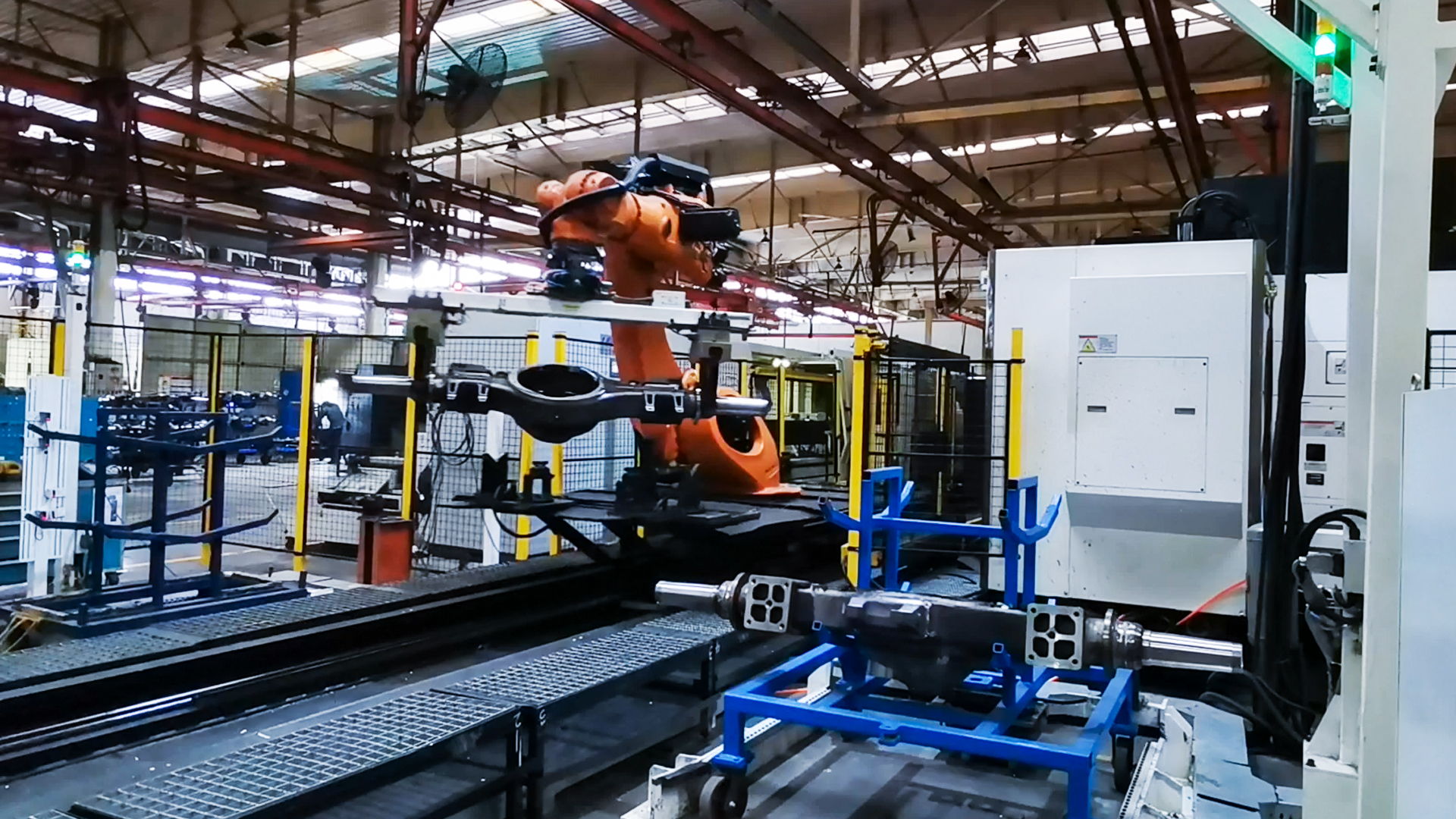
AI + 3D Vision-Guided Machine Tending of Axle Housings
Customer Demand
Mech-Mind General-Purpose "Eye + Brain" for Robots
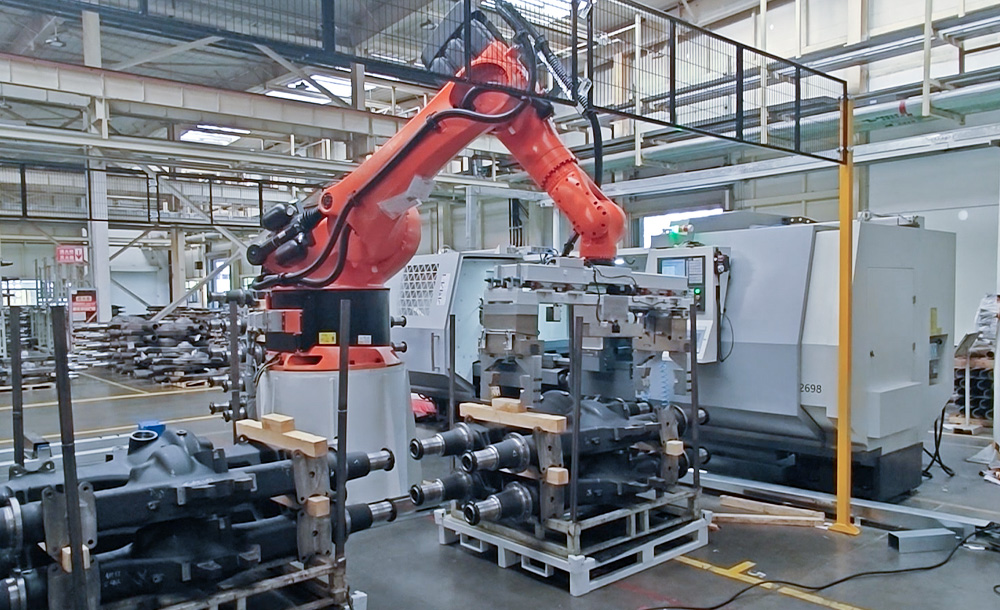 Project Site
Workflow:
Mech-Mind's "Eye + Brain" solution (including high-precision 3D cameras and AI software suites) enables the robot to accurately recognize and grasp axle housings, autonomously performing loading and unloading. The high-precision, large-field-of-view 3D camera captures high-quality point-clouds of parts with complex surfaces, and the AI brain performs pose estimation, path planning, collision detection, and real-time position correction to support reliable picks.
Advantages:
1. Captures high-quality 3D point clouds of axle housing with complex surfaces.
2. Fully covers large pallets and easily handles large-sized parts, thanks to a large field of view.
3. Integrated with the AI brain that includes our self-developed path planning and collision detection algorithms.
4. Guides the robot to reliably pick up axle housings with real-time position correction to reduce debugging time.
5. Adapts to a variety of axle housing specifications, boosting production-line efficiency.
Results:
-
Boosted production-line efficiency.
-
Increased stability and reliability in heavy-part handling.
-
Enabled rapid deployment and faster line changeovers.
-
Improved automation flexibility and production capacity.